
10 Best Retail Supply Chain Management Software in 2025
Team Locus
In this article

Key Takeaways
- Adopt retail supply chain management software to reduce logistics costs by up to 25 percent while improving operational margins and customer service efficiency.
- Use AI-powered route optimization to cut empty miles by 10–15 percent, increasing routing efficiency across retail, FMCG, and CPG industry delivery networks.
- Integrate ERP, WMS, and OMS systems into a unified platform to create one source of truth, reduce duplicate orders, and strengthen decision-making.
- Track shipments with real-time dispatch management for proactive issue resolution, reduced delivery delays, and fewer costly returns impacting overall customer satisfaction.
- Locus provides AI-driven orchestration, automated dispatch optimization software, and scalable visibility, enabling enterprises to transform logistics into a long-term strategic growth driver
Retail supply chain management software is a digital tool that helps retailers manage logistics more effectively. It connects inventory, fulfillment, and transportation data in one place. This integration makes decisions faster and cuts down on inefficiencies that increase costs.
A major challenge for most retailers is lack of visibility. A 2025 survey found that nearly 66% struggle to get real-time insights into costs, production, and logistics. Companies with strong visibility recover from disruptions almost five times faster.
Inefficient links with suppliers and partners contribute substantially to waste globally. Over US $163 billion in goods vanish annually due to overproduction or expiry.Many retailers continue using systems that slow response times. Others are adopting AI dashboards and control tower tools that provide live views of supply chain activity across regions.
This article reviews the top retail supply chain management software in 2025. It compares features and pricing, and explains why Locus is positioned as a leading option for enterprises seeking automation, visibility, and stronger operations.
Why SCM Software Is Crucial for Retail in 2025
Retail supply chain management software is crucial because it improves visibility, enables automation, enhances routing efficiency, and strengthens resilience against disruptions while reducing costs and supporting compliance.
- Visibility improves resilience: A new study by CyberMedia Research reveals that 57% of supply chain professionals cite insufficient visibility as their top operational issue. Companies with broader visibility recover from disruptions up to five times faster.
- Automation adoption is rising: Technavio notes that the SCM software market will grow by USD 24.87 billion between 2025 and 2029. Growth is led by AI-driven automation and event management.
- Transparency enables control: 96% of executives improved cost visibility with digital tools. 51% use predictive analytics for supplier collaboration.
- Visibility gaps persist: McKinsey highlights that 45% of companies can only see as far as their first-tier suppliers. Limited visibility reduces preparedness for supply chain shocks.
- Routing efficiency reduces costs: AI-powered automated route planning lowers empty miles by up to 15%. This directly cuts transportation costs and improves margins.
SCM software is the backbone of retail logistics, enabling scalability, cost control, and customer satisfaction in a competitive market.
Key Features to Look For in a Retail Supply Chain Management Software
The right retail supply chain management system software should do more than track inventory. It should connect processes, scale with demand, and provide visibility that reduces costs across the supply chain.
∙ Scalability
A modern platform must handle large product catalogs, multiple sales channels, and seasonal demand shifts.
For example, a fashion retailer managing 50,000 stock keeping units (SKUs) across online stores and physical outlets needs the system to scale smoothly during holiday sales. Without this scalability, orders pile up, deliveries get delayed, and customer experience suffers.
∙ Automation
Automation is now a core element of supply chain orchestration. It connects forecasting, dispatch, and routing to reduce errors and keep operations aligned with demand.
For retailers managing thousands of orders each day, automation improves delivery timelines and resource use by removing manual bottlenecks. These benefits are reflected in how modern logistics management workflows are designed to keep pace with demand.
∙ Real-Time Visibility
Supply chains often fail when teams cannot see where products or vehicles are at a given moment. A platform with a transport management system gives dispatchers live visibility of shipments, helping them spot issues before they escalate.
This level of visibility reduces returns caused by failed or delayed shipments. However, returns due to customer dissatisfaction, such as wrong sizes in fashion, require separate strategies.Retailers that build returns logistics strategies are already lowering these costs.
∙ Analytics and Reporting
Analytics turn raw supply chain data into actionable insights. With predictive reporting, retailers can understand cost drivers, track delivery performance, and identify risks earlier.
Many retailers are now using AI to strengthen reporting and decision-making by building AI for supply chain operations directly into their workflows.
∙ Integration
A strong retail supply chain management software integrates with ERP, WMS, OMS, and ecommerce platforms to create a single source of truth.
For example, when order data from an ecommerce site flows directly into the ERP and warehouse system, inventory updates happen instantly. This avoids duplicate entries, reduces errors, and keeps teams aligned.
∙ Routing Efficiency
Delivery costs are one of the largest expenses in retail supply chains. Platforms should provide strategic route planning, automated route planning, and logistics route planning that improve routing efficiency and minimize empty miles. These efficiencies are closely tied to how retailers design their inbound and outbound logistics.
∙ Compliance and Security
Retailers often operate across multiple regions with different regulations. Software should support compliance and data protection to keep operations consistent and reliable.
Top 10 Retail Supply Chain Management Software – Overview
To help enterprises identify the right fit, we compare ten leading retail supply chain management software solutions. These tools differ in scale, focus, and cost structure, but all aim to improve visibility and efficiency across retail supply chains. The table below offers a snapshot of their strengths.
Software
Ideal For
Key Features
Pricing
Standout Factor
Locus
Enterprise Retail, FMCG, 3PL, E-commerce
AI-powered orchestration, TDMS dispatch, auto-dispatch, dynamic route optimization
Custom
End-to-end logistics automation across middle and last mile
FarEye
Retailers and large enterprises
Real-time tracking, predictive optimization, dynamic rescheduling, customer engagement
Subscription (customized)
Focus on last-mile and returns experience
DispatchTrack
Retail, e-commerce, field services
Route optimization, live tracking, proof of delivery, engagement tools
Subscription (flexible plans)
Strong customer-facing delivery tools
Blue Yonder
Large retailers, manufacturers, distribution networks
Multimodal optimization, WMS-TMS integration, predictive planning
Enterprise licensing
Advanced AI for global planning and forecasting
Fulfillor
3PLs, warehouses, multichannel sellers
Inventory management, 150+ integrations, multilingual support, returns handling
Tiered/custom
Multilingual, cloud-native fulfillment management
Logility
CPG, retail, manufacturing, life sciences
Demand planning, inventory optimization, AI insights, supply chain design
Enterprise licensing
AI-first decision intelligence suite
Kinaxis
Global enterprises across industries
Concurrent planning, scenario modeling, control tower, order management
Enterprise licensing
Maestro platform unifying planning and execution
Infor Nexus
Global retailers, importers, consumer brands
Supplier collaboration, logistics visibility, trade compliance, payments
Enterprise licensing
Multi-enterprise supply chain collaboration
E2open
Enterprises with global networks, cross-border trade
Connected planning, logistics, trade compliance, channel performance
Enterprise licensing
Broad connected supply chain platform with embedded AI
Rose Rocket
Small-to-mid trucking companies, LTL carriers
Dispatch board, customer portal, driver app, invoicing, load boards
Starts $99/month
TMS designed specifically for carriers
Top 10 Retail Supply Chain Management Software – Detailed Comparison
1. Locus
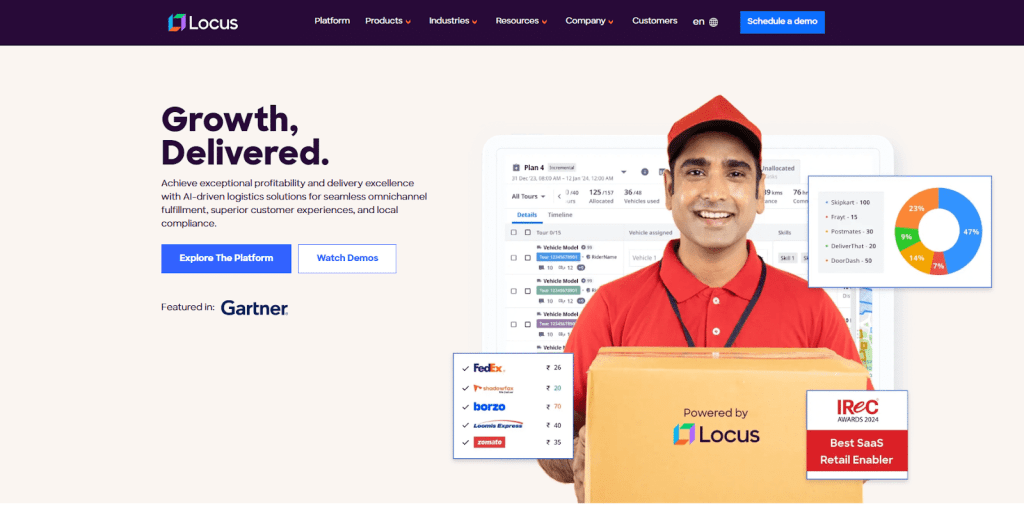
Locus is an AI-powered transportation management system designed for enterprises managing high-density deliveries across complex geographies. It combines real-time orchestration with automated dispatch, predictive insights, and multi-modal delivery optimization, built to support both middle-mile and last-mile workflows at scale.
Features of Locus:
- Auto-dispatch engine: Allocates deliveries using configurable business logic and fleet capacity.
- Real-time Control Tower: Monitors active shipments with dynamic alerts for exceptions and delays.
- Dynamic route optimization:Adjusts based on delivery priorities, traffic, and SLA constraints.
- Smart rider reassignment: Reallocates tasks in response to failed deliveries or last-minute changes.
- Returns and reverse logistics: Automates failed delivery handling and reattempt scheduling.
- ERP/WMS integration: Connects with SAP, Oracle, and legacy systems using robust APIs.
- Carbon tracking and emissions reporting: Measures CO₂ per route for ESG and compliance reporting.
Suggested read: How Supply Chains can Reduce Carbon Footprint with Logistics Planning Software
Locus is best for:
Retail chains, FMCG manufacturers, 3PL providers, and e-commerce businesses operating across regions with high delivery density and fragmented logistics infrastructure.
To explore how Locus optimizes last-mile operations for retail and e-commerce businesses, read the article on its dispatch management enhancements for last-mile logistics, featured by ManufacturingToday.
Locus pricing:
Locus offers a custom pricing model based on the size of the business and specific operational needs. Pricing is determined by factors such as return volumes, the complexity of integrations, and the scope of desired features. Businesses interested in a detailed pricing structure can contact Locus to schedule a demo and discuss their requirements.
2. FarEye
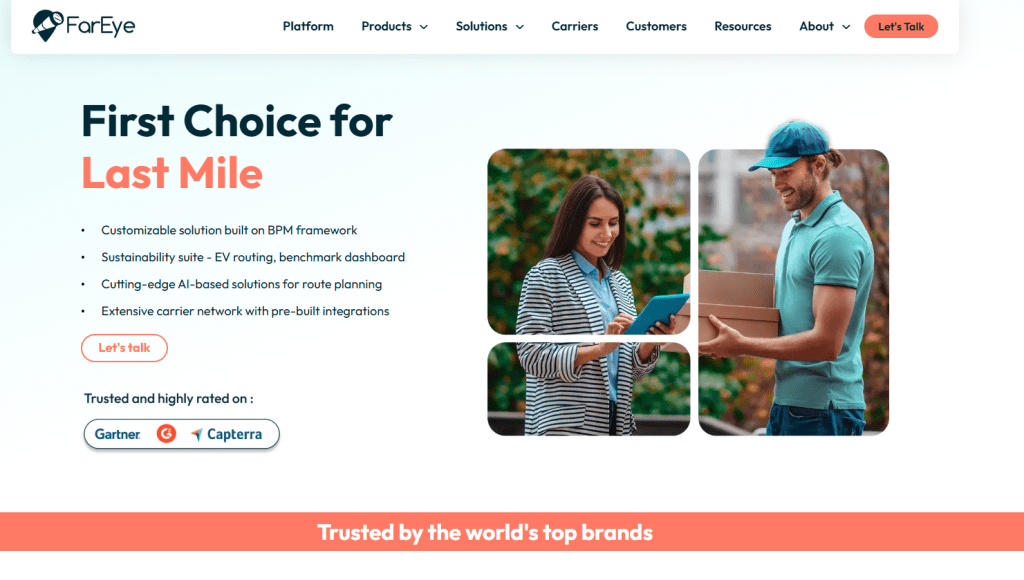
FarEye specializes in last-mile delivery optimization, offering a platform designed to improve delivery accuracy and enhance the returns experience. The solution integrates predictive tracking, dynamic rescheduling, and advanced customer engagement tools, all of which streamline reverse logistics processes for businesses.
Features of FarEye:
- Real-Time Tracking: Provides visibility into the entire delivery process, helping optimize operations and reduce delays.
- Predictive Delivery Optimization: Uses AI to predict and adjust delivery routes for faster and more accurate deliveries.
- Dynamic Rescheduling: Automatically adjusts delivery schedules to accommodate changes, ensuring timely returns management.
- Enhanced Customer Engagement: Tools to improve communication and satisfaction during the returns process.
FarEye is Ideal for:
- E-commerce and Retailers: Businesses aiming to enhance last-mile delivery efficiency and improve the returns experience for customers.
- Large Enterprises: Companies seeking scalable solutions for managing complex, high-volume returns processes.
FarEye’s Pricing:
FarEye offers a subscription-based pricing model, with costs tailored to business needs, including factors like return volumes and required features.
3. DispatchTrack

DispatchTrack is a leading provider of last-mile delivery solutions that helps businesses streamline logistics operations and enhance the customer experience. With its AI-powered platform, DispatchTrack offers features that improve route optimization, delivery visibility, and real-time tracking, making it an ideal choice for companies aiming to optimize last-mile logistics.
Features of DispatchTrack:
- Real-Time Tracking & Visibility: Get live tracking updates and full transparency for both drivers and customers, ensuring smoother deliveries and better customer engagement.
- Route Optimization: AI-driven algorithms optimize delivery routes in real-time, adjusting for traffic, weather, and priorities to reduce delays and operational costs.
- Customer Engagement Tools: DispatchTrack enhances the customer experience by providing tools for self-scheduling, mobile apps for drivers, and proof of delivery, making the process seamless and efficient.
- Performance Insights & Reporting: Data-driven analytics that help businesses track delivery performance, improve decision-making, and identify trends for better operational efficiency.
DispatchTrack is Ideal for:
- E-commerce & Retail: Businesses needing to optimize their last-mile logistics and improve delivery accuracy and customer satisfaction.
- Field Services & Building Materials: Companies that require fast, accurate scheduling, and full visibility to ensure timely deliveries of large, bulky items or services.
DispatchTrack’s Pricing:
DispatchTrack follows a subscription-based pricing model, offering flexibility based on business needs, including delivery volume and required features. Companies interested in detailed pricing can contact DispatchTrack for a personalized quote.
4. Blue Yonder (formerly JDA)

Blue Yonder provides an integrated TMS as part of its larger supply chain execution suite, used by enterprises looking to align transportation planning with inventory, demand, and warehouse operations. It supports predictive planning and real-time transportation optimization across global networks.
Features of Blue Yonder:
- Multimodal optimization: Plans and consolidates shipments across air, ocean, and ground.
- Demand-driven transportation planning: Aligns transport operations with forecasted inventory needs.
- WMS-TMS integration: Seamlessly connects warehouse and transport systems for unified execution.
- Network modeling tools: Simulates cost, route, and carrier scenarios for long-term planning.
- Freight settlement automation: Validates invoices and reconciles carrier payments.
Blue Yonder is ideal for:
Manufacturers, large retailers, and distribution networks require synchronized planning across warehousing, transportation, and demand forecasting.
Blue Yonder pricing:
Offered through enterprise licensing. Pricing varies based on solution scope, deployment model (cloud/on-premise), and user volume.
5. FulFillor
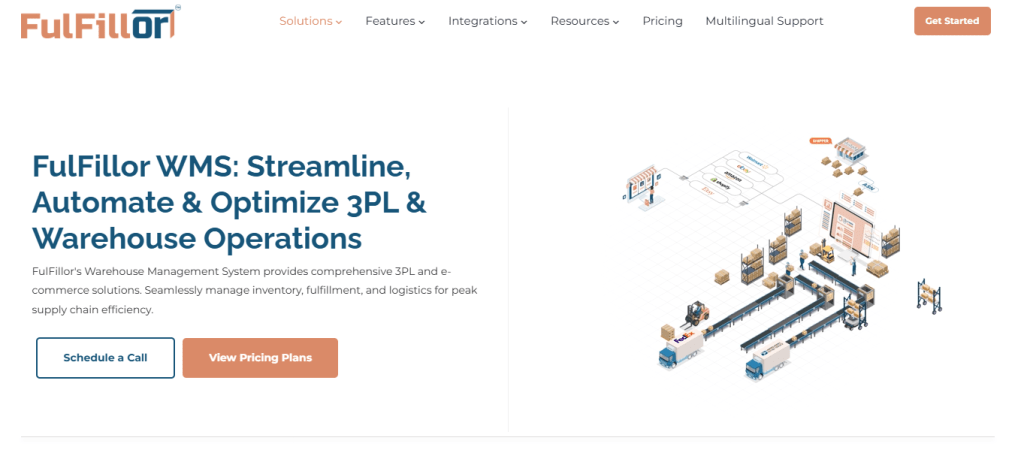
FulFillor is a SaaS-based warehouse and order management platform headquartered in the USA. It helps businesses streamline fulfillment by connecting with local warehouses, courier companies, and multiple sales channels. The system offers multilingual support and a cloud-based interface designed to simplify operations for 3PLs, e-commerce sellers, and retail chains.
Features of FulFillor:
- Inventory management: Real-time tracking of stock across warehouses.
- Order fulfillment automation: Pick, pack, and ship workflows optimized for speed and accuracy.
- Returns handling: Built-in support for returns and reprocessing.
- Over 150 integrations: Connects with shopping carts, marketplaces, couriers, and accounting platforms.
- Multilingual support: Interfaces available in English, Arabic, Spanish, Chinese, French, and more.
- Analytics and reporting: Provides dashboards for operations oversight and performance tracking.
FulFillor Is Ideal For:
3PL providers, warehouses, retail businesses, and multichannel e-commerce sellers that need scalable fulfillment and multilingual capabilities.
FulFillor Pricing:
Pricing depends on storage costs, order volume, shipping charges, and value-added services such as re-barcoding and repackaging. Packages are available for multi-channel sellers, 3PL providers, and enterprises, with quotes tailored to business needs.
6. Logility

Logility offers an AI-first supply chain management suite designed to integrate planning and execution across the end-to-end supply chain. Its cloud-based Decision Intelligence Platform supports demand planning, inventory optimization, supply chain design, and deployment, making it suitable for organizations seeking predictive insights and faster decision-making.
Features of Logility:
- Demand planning and forecasting: Uses AI to align production and inventory with customer demand.
- Inventory optimization: Balances stock levels across networks to reduce carrying costs.
- Scenario planning: Simulates demand and supply scenarios to support risk planning.
- Supply chain design and modeling: Optimizes networks to improve resilience and reduce costs.
- AI-powered insights: Delivers predictive and prescriptive recommendations for decision-making.
Logility Is Ideal For:
Large enterprises in industries such as consumer packaged goods, food and beverage, retail, life sciences, and industrial manufacturing that require advanced planning and visibility across global supply chains.
Logility Pricing:
Enterprise licensing model with pricing based on deployment scope, modules selected, and user volume.
7. Rose Rocket

Rose Rocket is a cloud-based TMS built specifically for trucking companies and LTL carriers. Its interface prioritizes usability, with tools for dispatchers, drivers, and customers to manage freight from booking through delivery, all in one platform.
Features of Rose Rocket:
- Dispatch management board: Centralizes trip creation, assignment, and real-time status updates.
- Customer portal: Allows shippers to book loads, track freight, and retrieve documents.
- Mobile driver app: Enables POD capture, real-time communication, and route details.
- Billing and invoicing tools: Automates rate calculations and invoice generation.
- Load board integration: Connects with external marketplaces to fill backhauls or gaps.
Rose Rocket is ideal for:
Small to mid-sized carriers, regional trucking businesses, and LTL providers seeking modern tools without enterprise-level complexity.
Rose Rocket pricing:
Starts at $99/month with tiered plans based on the number of users and required modules.
8. Kinaxis
Kinaxis offers an AI-first supply chain platform that connects planning and execution in one suite. The Maestro platform supports concurrent planning, real-time visibility, and scenario analysis so teams can respond faster to demand, supply, and logistics changes.
Features of Kinaxis:
- Concurrent planning: Aligns demand, supply, inventory, and S&OP in a single model.
- Control Tower: Monitors events, exceptions, and KPIs with drill-downs and alerts.
- Scenario planning: Tests “what-if” options to assess service, cost, and capacity impact.
- Demand and supply planning: Forecasts demand and synchronizes supply, production, and scheduling.
- Inventory optimization: Sets safety stock and policies across sites and channels.
- Order and transportation: Supports order promising, track-and-trace, and exception handling.
- Integration and security: Connects to ERPs and enterprise systems with governed data flows.
Kinaxis Is Ideal For:
Global enterprises in industries such as automotive, high-tech, life sciences, consumer products, aerospace and defense, and industrial manufacturing that need unified planning and execution with rapid response to disruptions.
Kinaxis Pricing:
Enterprise licensing with custom quotes based on modules, user scope, and deployment. Demo and evaluation available on request.
9. Infor Nexus

Infor Nexus is a multi-enterprise supply chain network that unifies orders, production, logistics, and payments. It helps retailers and brands collaborate with suppliers, manage global shipments, and handle trade compliance on one platform.
Features of Infor Nexus:
- Supplier collaboration: Share purchase orders, forecasts, and milestones with factories and vendors.
- Order management: Track PO lifecycle from creation to final delivery with milestone control.
- Logistics visibility: Monitor ocean, air, and ground shipments with carrier and 3PL connectivity.
- Trade compliance: Manage documents, screenings, and regulatory checks for cross-border flows.
- Financial services: Support for early payment, invoice matching, and freight settlement.
- Exception management: Alerts and workflows to resolve delays and data gaps.
- Analytics and KPIs: Performance dashboards for suppliers, lanes, and cycle times.
- Integrations: Connects to ERP, WMS, TMS, and broker systems through standardized interfaces.
Infor Nexus Is Ideal For:
Global retailers, consumer brands, and importers with complex supplier networks and high volumes of international shipments that need unified visibility and collaboration.
Infor Nexus Pricing:
Enterprise licensing with custom quotes based on modules, transaction volumes, and ecosystem participants. Demo and evaluation available on request.
10. E2open
E2open is a connected supply chain platform that brings together planning, execution, and partner collaboration. It supports end-to-end processes across direct materials, logistics, global trade, and channel operations with embedded analytics and AI.
Features of E2open:
- Connected planning: Aligns demand, supply, and inventory with real-time partner inputs.
- Logistics management: Plans, executes, and tracks shipments across modes with carrier connectivity.
- Global trade compliance: Screening, duty management, filing, and document workflows using curated trade content.
- Control tower and visibility: Event monitoring, exceptions, and track-and-trace across tiers.
- Direct procurement collaboration: Multi-tier supplier engagement for orders, commits, and milestones.
- Channel and distribution: Partner collaboration, rebates, and channel performance management.
- AI and analytics: Embedded intelligence for forecasting, risk signals, and KPI dashboards.
- Ecosystem integrations: Connections to ERPs, WMS, TMS, brokers, and carriers.
E2open Is Ideal For:
Large enterprises with global supplier networks, multi-mode logistics, and cross-border trade that need one platform for visibility and coordination across partners.
E2open Pricing:
Enterprise licensing with custom quotes based on solution suites, transaction volumes, and number of ecosystem participants. Demo and consultation available on request.
From Cost Center to Growth Driver: The Value of Modern Supply Chain Software
Choosing the right retail supply chain management software can decide how well a business adapts to rising customer expectations, complex global networks, and increasing cost pressures. The ten platforms we reviewed show the range of solutions available, from specialized planning tools to end-to-end orchestration systems.
For enterprise retailers, the key is finding a solution that delivers visibility, automation, and scalability in one place. That is where Locus stands out.
With AI-powered dispatch management, predictive routing, and real-time control, Locus helps enterprises turn logistics into a strategic advantage instead of just a cost center.
To strengthen your supply chain, book a demo and explore how Locus supports efficiency, cost reduction, and customer satisfaction at scale.
Frequently Asked Questions (FAQs)
1. What is the biggest challenge retail supply chains face today?
Balancing rising customer expectations with cost control. Visibility gaps, rising returns, and complex multi-channel fulfillment are the most common hurdles for modern retail operations.
2. Can retail supply chain management software reduce returns?
Yes. By improving demand forecasting, shipment accuracy, and real-time tracking, software reduces mismatches and delays that often lead to returns.
3. How does integration impact supply chain performance?
Integrating ERP, WMS, OMS, and logistics systems creates a single source of truth. This reduces duplicate data, accelerates order processing, and strengthens decision-making across the supply chain.
4. Is cloud-based retail supply chain software better than on-premise?
Cloud systems scale faster, update automatically, and provide remote access. They are generally more cost-effective and secure for enterprises managing complex, multi-region operations.
5. Which solution is best for enterprises with high delivery density?
Enterprises handling thousands of daily deliveries benefit most from AI-driven orchestration. Solutions like Locus combine dispatch automation, routing efficiency, and real-time visibility to streamline operations at scale.

![Cloud-based Dispatch Software: A Complete Guide [2025]](https://cdn.sanity.io/images/w495w6xa/production/510cdd269c36b7d8d212790827ba380d1d8c1550-1200x675.webp?fm=webp&q=90)